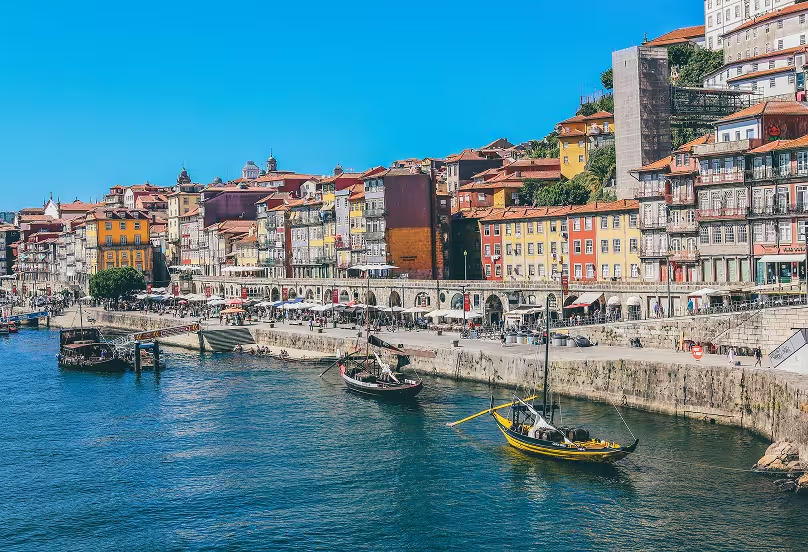
Porto is built on a granite gorge where the Douro meets the Atlantic, which is why the old city stacks up the hillside in tiers and why every walk seems to end at a river view. It gave the country its name, gave the world port wine, and has spent the past decade being sold as the cheaper, more authentic alternative to Lisbon.
Part of that is true and part of it is out of date. On rent, Porto is genuinely cheaper. On the price of buying a home, the gap with Lisbon is narrower than the guides claim and it is closing.
This guide covers both, using the prices registered with the tax authority rather than the ones advertised on portals, plus where to live, how the expanding Metro changes the map, and what is worth your time once you are here.
Key Takeaways: Exploring Porto in Six Steps
- Know the real gap with Lisbon. Porto's registered median sale price is about 31% below Lisbon's, not the 40% often quoted, and Porto is now rising faster. On rent the discount is larger and holds up better.
- Set a monthly number first. A single person renting a one-bedroom flat and living comfortably needs roughly 1,700 to 2,400 euros a month. A couple in a two-bedroom flat lands around 2,300 to 3,000. Rent is the swing factor.
- Separate advertised prices from registered prices. Portal asking prices sit well above what gets signed at the notary, and Statistics Portugal publishes the registered figure to parish level for Porto every quarter.
- Read the parish data before you believe the regeneration story. Campanhã, the district everyone calls the next big thing because of the high-speed rail plans, is the one parish in Porto where registered prices actually fell over the past year. That is a signal worth understanding before you buy on the promise.
- Get someone on your side of the table. Buyers with a foreign tax domicile pay a premium in Porto, though a smaller one than in Lisbon. Ola Estate covers Porto and the north, represents the buyer or the tenant rather than the seller, searches the whole market, and has its lawyers review every contract, which is where a foreign buyer's information gap gets closed.
- Check what is actually open. The Metro's Rosa line, widely reported as a 2024 then a 2025 then an early-2026 opening, is now scheduled for the first quarter of 2027. The Rubi line to Gaia is under construction. Plan around the real dates.
Porto at a Glance
The historic core, from the Ribeira up to the Sé and across the Dom Luís I bridge to the port lodges of Vila Nova de Gaia, is a UNESCO World Heritage Site. Gaia is a separate municipality on the south bank, which matters for tax and for which town hall governs the flat you buy, even though the two sides read as one city.
Porto Versus Lisbon: What the Data Actually Says
This is the comparison most people arrive with, so it is worth settling with numbers before anything else.
Three takeaways from that table.
- On buying, the gap is about 31%, not 40%. And it is narrowing. Porto's registered prices grew faster than Lisbon's over the past year, and in the first quarter of 2026 Porto accelerated to 21.6% year on year against Lisbon's 15.3%. If both hold their current pace, the discount keeps shrinking.
- On renting, Porto is the better deal. The new-contract median is about 18% below Lisbon's, and daily costs are broadly similar, so a renter's budget stretches meaningfully further here.
- The foreign-buyer premium is half Lisbon's. In the Porto metro area, buyers with a foreign tax domicile paid 16.9% more per square metre than domestic buyers, against 34.5% in Greater Lisbon. The standard line that foreign money is the main driver of Porto prices does not survive the data as well as it does for Lisbon.
What Property Costs in Porto
The registered numbers
Ignore the portal asking prices, which typically sit above 4,000 euros per square metre. The figure that matters is what was declared when transfer tax was paid. Statistics Portugal publishes it quarterly, with the first quarter 2026 figures released on 17 July 2026.
For the municipality of Porto, the registered median across the 12 months to March 2026 was 3,510 euros per square metre, up 16.7% year on year. That makes Porto the second most expensive large municipality in the country after Lisbon, though a long way behind it and behind Cascais, Oeiras and Loulé among the smaller high-price municipalities.
For context, the national median in the first quarter of 2026 was 2,337 euros per square metre, and the Porto metropolitan area as a whole was 2,552.
Registered sale prices by Porto parish
Porto has only seven parishes, several of them unions of older ones, which makes the parish table unusually complete. All figures are registered medians for the 12 months to March 2026.
Two of these matter more than the rest.
- Foz do Douro is the money. The union of Aldoar, Foz do Douro and Nevogilde, out where the river meets the sea, is the most expensive part of the city at 4,252 euros per square metre. It is Porto's seafront-and-old-money quarter and it behaves like one.
- Campanhã is the anomaly. It is the only parish in Porto where registered prices fell over the past year, down 7.4% to 2,695 euros per square metre. This is the parish everyone points to as the next frontier, because the high-speed line and major regeneration are planned around Campanhã station. The reputation and the tax data are pointing in opposite directions right now, which is exactly the situation where the promise and the reality need separating before you commit.
The historic centre union (Cedofeita, Santo Ildefonso, Sé and the rest) is the fastest riser at 23.4%, and it is also the parish with the most transactions, so it is the most liquid part of the market.
New builds versus existing stock
As across Portugal, new stock carries a premium, though Porto's is smaller than Lisbon's. New build in the old city almost always means a full renovation of a historic building rather than new construction, so the question is what was actually replaced: the structure and services, or only the finishes. Inside the UNESCO perimeter there are heritage limits on what you can change externally.
What you pay on top of the price
The advertised price is not the total. Budget separately for:
- IMT, the property transfer tax, on a sliding scale against the price or taxable value, whichever is higher
- Stamp duty at 0.8% of the price
- Notary and land registry fees
- Legal fees, if your agency does not include contract review
- Mortgage costs if borrowing: valuation, arrangement and stamp duty on the loan
- IMI, the annual municipal property tax, from the following year
You will also need a Portuguese tax number before you can sign the promissory contract. We cover the transfer tax bands, the promissory contract and non-resident mortgages in separate guides. One Porto-specific point: check whether the flat is governed by the Porto or the Gaia town hall, because IMI rates and short-term rental rules differ between municipalities.
What It Costs to Rent in Porto
The official numbers
Statistics Portugal resumed publishing new-contract rent statistics in June 2026 with a wider, revised series. For the first quarter of 2026, the median rent on new contracts signed in the municipality of Porto was 14.29 euros per square metre, the highest in the Porto metropolitan area and second nationally only to Lisbon.
The metro area has the widest internal spread in the country. Within it, the cheapest municipality was Arouca at 5.21 euros per square metre and the most expensive was Porto city at 14.29, a range of over 9 euros. That is the single most useful fact for a renter: step one municipality out from the city and the price drops sharply.
Translated into monthly rent, using the Porto city median:
The left column is what the median contract implies. The right is what furnished, English-facing listings in the Baixa and Foz ask. Both are true: the furnished short-notice market marketed to internationals is a different segment from the unfurnished twelve-month lease a Porto family signs in Paranhos, and the official median blends them.
What that means in practice
- Unfurnished flats are meaningfully cheaper than furnished and are what most long-term contracts cover. Budget for appliances.
- Rooms in shared flats start around 350 euros and typically run 400 to 600 in the central parishes.
- Crossing to Vila Nova de Gaia, or out to Matosinhos or Gondomar, drops the price for the same flat while staying on the Metro.
- Rent is usually quoted excluding condominium charges, water, electricity and gas. Confirm what is included before comparing two flats.
Deposits, guarantors and paperwork
Porto landlords commonly ask for two to three months of rent as a deposit plus the first month in advance, and often a Portuguese guarantor (fiador) or several months up front instead. Expect to show a tax number, proof of income, an employment contract or company documents, and identification. Insist that the lease is registered with the Tax Authority: an unregistered contract cannot be used for the rent tax deduction or for residency procedures, and leaves you outside the protections of the tenancy law. We have a separate guide on the full document list.
What changed in the rental law in 2026
- The 2% cap on new contracts was repealed in July 2026, so new leases follow the market.
- Existing contracts still follow the annual coefficient, a maximum 2.24% increase for 2026, notified in writing within the legal window.
- Tenants can deduct rent against income tax, up to 900 euros in 2026 and 1,000 in 2027, for leases that qualify as moderate rent and are registered with the Tax Authority.
Cost of Living in Porto in 2026
A realistic monthly budget
Porto runs roughly 5 to 15% below Lisbon overall, with almost all of the saving in rent. The ranges below are working estimates rather than official statistics, and assume you cook most evenings, use public transport and eat out two or three times a week.
Add schooling if your children are not going into the public system. International school fees in the Porto area start around 8,000 euros a year and rise from there at the established British, German and international schools.
Utilities and the weather
Porto is cooler and considerably wetter than Lisbon. Winter is grey and rainy, and most housing has no central heating and poor insulation, so winter electricity bills climb as everyone runs heaters and dehumidifiers. Budget 80 to 150 euros a month for electricity, water and waste on a two-bedroom flat, higher from December to February. When viewing in summer, ask which way the flat faces, whether the windows are double-glazed, and whether there is any heating.
Food, coffee and eating out
Porto's food scene is arguably the best value in the country. A coffee at the counter is under a euro. A lunchtime prato do dia in a local tasca is 8 to 12 euros. A mid-range dinner for two with wine is 40 to 65 euros. The city's own dish, the francesinha, a layered meat sandwich under melted cheese and a beer-and-tomato sauce, is a meal in itself and a minor local religion.
Supermarkets are cheap: Continente, Pingo Doce and Auchan for the weekly shop, Lidl and Mercadona for price. The Mercado do Bolão, restored and reopened, is the landmark market; Matosinhos is where to eat grilled fish straight off the Atlantic.
Healthcare
Legal residents can register with the national health service (SNS) through a local health centre for low-cost or free care, with waiting times for non-urgent specialists the main drawback. Most residents who can afford it also carry private insurance, which is inexpensive by international standards and gives quick access to private hospitals such as CUF Porto, Hospital da Luz and the Hospital da Arsábida.
Salaries, and the same tension as everywhere
The national minimum wage in 2026 is 920 euros gross a month, netting 818.80 after social security, and the average monthly wage was 1,694 euros in 2025. Porto salaries broadly track the national average, held up by a growing technology sector, shared service centres, the port and logistics, tourism and the universities. As everywhere in Portugal, the housing math is comfortable on a foreign income and tight on a local one, which is why Porto too has a live housing-affordability debate.
Porto Neighbourhoods: Where to Live
Porto is compact and the parishes are few, so most of the decision is about how central, how touristy, and which side of the river.
The historic core
The Ribeira, the Sé and the Baixa are spectacular and hard to live in: old buildings, few lifts, steep lanes, and a high share of short-term rentals. They are excellent for a first stretch when you want to be in the middle of it, and many people then move out for space and quiet.
The livable middle
Cedofeita and the Miguel Bombarda gallery district are where the independent, creative side of Porto concentrates, walkable and full of small shops. Bonfim, just east of the centre, is the value play that keeps getting named: central, still mixed, and changing fast. Boavista is the business spine, anchored by the Casa da Música, with wide avenues and a more residential feel the further west you go. Paranhos and Antas are solid residential districts near the universities and the São João hospital.
The seafront and the south bank
Foz do Douro is the address, where the river opens to the Atlantic: low-rise, elegant, quiet and expensive. Matosinhos, just north, gives you the beach and the best fish restaurants in the region for less, and it is a separate municipality on the Metro. Across the water, Vila Nova de Gaia is its own town, home to the port lodges, with a riverside that looks straight back at the Porto skyline and prices below the city for the same view. Anyone chasing value with a Metro connection should look hard at Gaia, Matosinhos and Gondomar.
Getting Around Porto
The Metro and the Andante system
Porto's Metro is a light-rail network, part underground in the centre and overground in the suburbs, and it is clean, cheap and expanding. It runs on the Andante card, a zone-based system shared with buses and urban trains, so a single validated trip covers whatever combination of modes you use within the time and zones.
The airport sits on the Purple Line (formerly the Violet), an 11 kilometre ride to the centre, which is one of the cheapest airport-to-city rail links in Europe. Matosinhos, Gaia and the beaches are all on the network.
The new lines
Two major projects are under way and both are misreported in older guides.
- The Rosa (Pink) line will run underground from São Bento in the Baixa to the Casa da Música at Boavista, with new stations at the Hospital de Santo António and Praça da Galiza. It was promised for 2024, then 2025, then early 2026. The tunnelling is finished, but Metro do Porto now expects commercial operation in the first quarter of 2027 after certification and safety testing.
- The Rubi line will add 6.7 kilometres and eight stations from the Casa da Música across a new Douro bridge to Santo Ovídio in Gaia, connecting to the Yellow Line and the future high-speed station. Construction runs through 2026 and beyond.
If you are buying near a planned Rosa or Rubi station on the assumption it opens imminently, adjust the timeline.
Trains, walking and cars
São Bento, with its famous tiled hall, handles regional and urban trains; Campanhã is the main long-distance station for Lisbon, the Douro line and the future high-speed link. Lisbon is around three hours by fast train now and planned to fall sharply once high-speed rail opens later this decade.
The centre is walkable if you are fit, with the same caveat as Lisbon: it is steep, and the granite cobbles are slippery in the rain, which Porto gets a lot of. A car is more useful here than in Lisbon for reaching the Douro valley and the northern coast, and parking is easier.
What to See in Porto
The riverfront and the bridges
Start at the Ribeira, the medieval waterfront of stacked houses and arcades, and walk out onto the Dom Luís I bridge, the double-deck iron arch by a student of Eiffel. The Metro and pedestrians cross the top deck for the best view in the city; traffic and a walkway cross the bottom. On the Gaia side, the cable car drops you to the port lodges and the riverside.
The landmark buildings
- Livraria Lello, the neo-Gothic bookshop with the crimson staircase, one of the most beautiful and most crowded in the world. Book a timed ticket, which is redeemable against a book, and go at opening.
- São Bento station, free to enter, its hall lined with 20,000 tiles depicting Portuguese history.
- Clérigos Tower, the baroque bell tower you climb for the panorama.
- Bolsa Palace, the 19th-century stock exchange with the extravagant Arab Room, seen on a guided tour.
- The Sé, the fortress-like cathedral at the top of the old town, with a Romanesque core and a cloister of tiles.
- Igreja de São Francisco, plain outside and entirely gilded within, plus catacombs below.
Port wine in Gaia
The port houses are all on the Gaia side: Taylor's, Graâham's, Sãndeman, Cockburn's, Cálem and the rest, most offering cellar tours and tastings. Book ahead in season. For the full picture, the World of Wine complex above the lodges is a cluster of museums covering wine, cork and the region, with river views and restaurants.
Museums and gardens
- Serralves, the country's leading contemporary art museum, in an Art Deco villa set in one of the best parks in Portugal, out towards Foz.
- Casa da Música, Rem Koolhaas's concert hall at Boavista, worth a tour even without a concert.
- Soares dos Reis Museum, the fine-art collection in a former royal palace.
- Palácio de Cristal gardens, terraced above the river with peacocks and one of the best sunset views.
- Crístal and the Foz promenade, for the walk from the river mouth up the coast.
What to Do Beyond the Sights
Eating and drinking
Eat the francesinha at least once and argue about who does the best sauce. Beyond it: tripas à moda do Porto (the tripe dish that gave the city's people their nickname, tripeiros), grilled fish at Matosinhos, and the lunchtime prato do dia everywhere. The wine to drink young and cheap is the Douro red; the wine to drink slowly is the port from across the river.
The Mercado do Bolão is the restored landmark market. For a night out, the Galerias de Paris and Rua de Cedofeita streets, or the riverside in Gaia. LX-style warehouse dining is happening around the eastern districts as they regenerate.
Beaches
Porto is one of the few cities where you reach an ocean beach on the Metro. Matosinhos is the big city beach, wide and good for surfing and surf schools. Foz do Douro has smaller coves and a promenade. Further up the coast, Vila do Conde and Póvoa de Varzim. The water is Atlantic and cold, colder than Lisbon.
The Douro valley
The single best day trip in the north, and one of the world's oldest demarcated wine regions. Take the train up the Douro line from São Bento, one of the most scenic rail journeys in Europe, hugging the river past terraced vineyards to Pinhão and Régua. Or take a river cruise. The quintas (wine estates) offer tastings and lunch, and autumn brings the harvest.
Other day trips
- Guimarães, an hour away, the birthplace of Portugal, with a medieval centre and castle.
- Braga, 50 minutes, a religious capital with the Bom Jesus sanctuary and its baroque stairway.
- Aveiro, 50 minutes, canals, moliceiro boats and Art Nouveau.
- Viana do Castelo, up the coast, for the Minho and the hilltop basilica.
The calendar
São João, on the night of 23 June, is the great Porto festival: the whole city out in the streets, grilled sardines, bonfires, music, hot-air balloons, and the strange tradition of hitting strangers on the head with squeaky plastic hammers. It is one of the best street parties in Europe and, like Lisbon's Santo António, the city does it for itself. The Serralves em Festa arts weekend in spring and the autumn Douro harvest round out the year.
Working and Earning in Porto
Porto has built a real technology and services economy over the past decade. International companies have opened engineering and shared-service centres here, drawn by the lower salaries and the universities, and there is an active startup scene. Beyond tech: tourism and hospitality, the port and logistics at Leixões, traditional industry in the metro area, and the universities and hospitals.
Salaries remain the constraint, which is exactly why the international offices are here. On a foreign salary or a remote contract, Porto is comfortable. Competing for a local job means looking hard at the numbers against the rent. Coworking is well provided, with desks typically 120 to 280 euros a month.
What Changed in Porto in 2026
- Registered prices accelerated. Porto grew 21.6% year on year in the first quarter, faster than Lisbon, narrowing the gap between the two cities.
- The Rosa metro line slipped to 2027. Tunnelling is done but certification pushed commercial opening to the first quarter of 2027.
- The tourist tax held at 3 euros. Raised from 2 to 3 in December 2024 and unchanged for 2026, capped at seven nights, under-13s exempt.
- The national rental law was reformed. The 2% cap on new contracts was repealed and the rent tax deduction for tenants was introduced.
- Border procedures changed. The EU Entry/Exit System became fully operational across the Schengen area on 10 April 2026, replacing passport stamps with biometric records for non-EU short-stay travellers. ETIAS, the separate pre-travel authorisation, is expected later in 2026.
Things People Get Wrong About Porto
- That it is 40% cheaper than Lisbon to buy. On registered prices it is about 31%, and the gap is closing.
- That Campanhã is a sure thing. It is the regeneration story everyone repeats, and it is the one parish where registered prices fell last year.
- That Gaia is a suburb. It is a separate municipality with its own town hall, tax rates and rules, even though it looks like part of the city.
- That it always rains. It rains more than Lisbon, especially in winter, but summers are warm and dry. Bring a jacket for the shoulder seasons.
- That the francesinha is just a sandwich. It is a large, rich, sauce-drenched meal. Order one between two the first time.
- That you can skip the tax number. You need a NIF before you can rent, buy, open a bank account or set up utilities.
Frequently Asked Questions
Is Porto cheaper than Lisbon?
On renting, yes, by roughly 18% on the median new contract, and daily costs are similar. On buying, the registered median sale price is about 31% below Lisbon's, but Porto is rising faster, so the gap is narrowing.
How much money do you need per month to live in Porto?
A single person renting a one-bedroom flat needs roughly 1,700 to 2,400 euros a month for a comfortable life. A couple in a two-bedroom flat needs 2,300 to 3,000. A family of four with international schooling should plan on 4,000 euros and up.
What is the average rent in Porto in 2026?
The median rent on new contracts signed in the municipality in the first quarter of 2026 was 14.29 euros per square metre, according to Statistics Portugal, which works out to around 860 euros for a 60 square metre one-bedroom and 1,215 euros for an 85 square metre two-bedroom. Listings aimed at internationals ask more, and stepping out to Gaia or Matosinhos costs less.
What is the price per square metre in Porto?
3,510 euros per square metre as a registered median across the 12 months to March 2026. By parish it ranges from around 2,695 in Campanhã to 4,252 in the Foz do Douro union.
Which is the best neighbourhood in Porto to live in?
For families with budget, Foz do Douro and Boavista. For young professionals, Cedofeita and Bonfim. For value with a Metro link, Vila Nova de Gaia, Matosinhos and Gondomar. For a first stretch while you learn the city, anywhere central with a lift.
Can foreigners buy property in Porto?
Yes. Portugal places no restriction on ownership by nationality or residency. You need a Portuguese tax number, and non-residents face different transfer tax treatment and stricter mortgage terms than residents.
Is Porto a good place to live?
It suits remote workers, families, retirees and anyone who wants a walkable riverside city with excellent food, real character and lower costs than Lisbon. The trade-offs are a smaller job market than Lisbon, wetter winters, and unheated older housing.
Is Porto safe?
Portugal is among the safest countries in the world and violent crime in Porto is rare. Pickpocketing happens in the tourist core and on busy transport. Ordinary care is enough.
Do you need a car in Porto?
Not inside the city, which is walkable and has the Metro, buses and urban trains on one card. A car helps for the Douro valley and the northern coast, and parking is easier than in Lisbon.
How many days do you need in Porto?
Three full days covers the centre, the port lodges in Gaia and Foz. Add a fourth for a day up the Douro valley and a fifth for Guimarães or Braga.
Planning a Move to Porto
The published data gives you the map. It does not tell you whether the Campanhã flat is a bargain or a bet, what the building's roof is like, or what the seller will actually take.
Ola Estate works across Porto, Gaia, Matosinhos, Braga and the north, in English, Portuguese and Russian. We search the whole market rather than one agency's listings, represent the buyer or the tenant rather than the seller, have our lawyers review every contract before you sign, and run a licensed mortgage broker who submits to several banks at once so you compare real offers rather than one bank's opening position.
Tell us what you are looking for and we will come back with a shortlist that fits, including video tours if you are still abroad.
Table of content
Discover more regions
Discover more practical guides and local insights
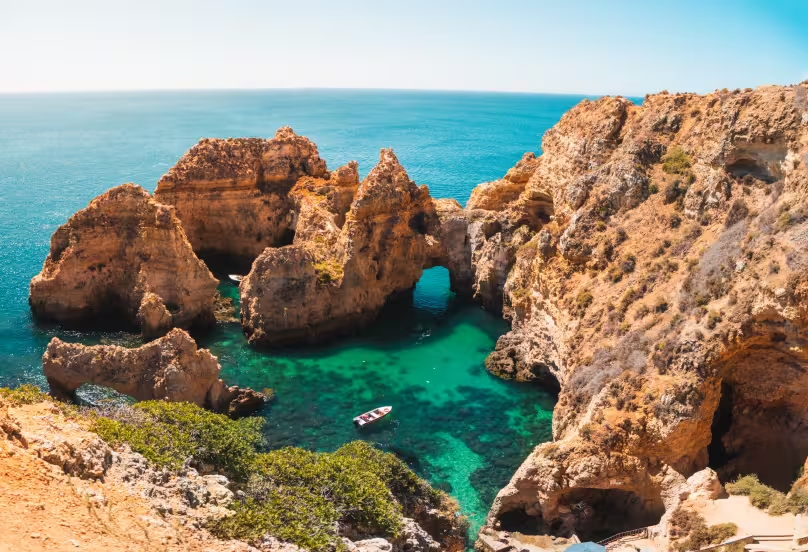
Explore the Algarve: Property Prices, Rent, Cost of Living and Where to Live in 2026
Experience the beauty of the Algarve with our expert guidance.
Explore Coimbra: Property Prices, Rent, Cost of Living and What to Do in 2026
Let our Coimbra experts guide you. We’ll be with you every step of the way, advocating for your best interests.