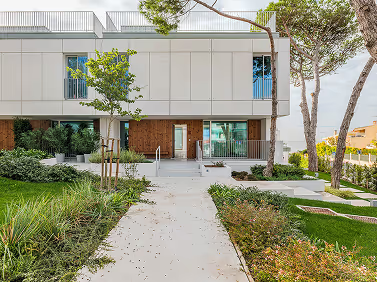

You do not need to live in Portugal, hold a visa, or carry a Portuguese passport to borrow from a Portuguese bank. Foreign buyers from the US, UK, EU, and further afield finance homes in Lisbon, Porto, the Algarve, and Cascais every week, often without ever setting foot in a branch. What changes for a non-resident is the deposit, the paperwork, and the margin added to your rate.
One point trips up nearly every guide on this topic, and it decides how much cash you actually need. Most articles repeat that non-residents are “capped at 60% to 70%” as if it were Portuguese law. It is not. Below is the rule that really applies, what banks offer in 2026, and how the European Central Bank’s June decision changed the maths for anyone signing a variable loan.
Key Takeaways: The Non-Resident Mortgage Process
The path from start to keys, in seven steps:
- Get a Portuguese NIF and open a Portuguese bank account. Mandatory groundwork for any purchase. Both can be arranged through a representative without travelling.
- Submit your file and get pre-approval. A broker sends your income documents to several banks for preliminary offers. This stage is not final approval, so do not pay a deposit or commit to a property yet.
- Clear compliance and get approval in principle. The bank runs legal and source-of-funds checks (about three to four weeks) and issues its standardised offer, the FINE, valid for 90 days.
- Find the property and agree on a price. A buyer’s agent can run the search and viewings on your behalf. With approval already in hand, you can move with confidence.
- Bank valuation. The bank orders an independent appraisal and confirms the final loan amount. This happens before the promissory contract, not after.
- Sign the promissory contract (CPCV) and pay the deposit. The deposit here (the sinal, usually 10% to 20%) is the first slice of your down payment. Price and terms are now fixed.
- Notary deed (Escritura). You sign before a notary, the mortgage issues, and you own the property.
Quick facts
- No residency required. You only need a Portuguese tax number (NIF), not a visa or citizenship.
- Down payment. How much of your own money you need depends on status: EU citizens around 20%, non-EU nationals with Portuguese residency about 25% to 30%, and non-residents buying from abroad usually 30% to 40%.
- Rates (2026). Most non-resident buyers end up with an all-in rate (the TAEG) of roughly 3.5% to 5%. That is the Euribor base index plus each bank’s spread, not Euribor on its own.
- Timeline. Usually about two to three months from application to signing.
Can a Non-Resident Actually Get a Mortgage in Portugal?
Yes. Portugal places no restriction on foreigners owning property or borrowing against it. EU and non-EU buyers have the same legal right to buy and finance a home as Portuguese citizens. Banks treat residency as a risk factor, not a barrier.
What does not work is using your home-country bank. A UK, US, or Canadian lender will almost never mortgage a Portuguese property, so you borrow from a Portuguese institution instead. The larger ones run English-speaking teams that handle international files as routine business.
Banks generally sort applicants into three tiers: Portuguese residents (easiest approval), non-residents living in the EU or EEA (usually straightforward), and non-residents outside Europe (workable, with more documentation and a larger deposit).
The Loan-to-Value (LTV) Myth: What the Rule Actually Says
This is the most repeated error in non-resident mortgage guides, and it directly changes how much you need in the bank. Loan-to-value, or LTV, is simply the share of the price the bank will lend.
Portugal has no loan-to-value cap based on nationality or residency. The ceiling comes from a macroprudential recommendation issued by Banco de Portugal, and it sets the same limit for everyone:
- 90% of the price or valuation for a primary, permanent residence
- 80% for any other purpose, including second homes and investment property
- 100% only for a property already owned by the bank
Most non-resident purchases are second homes, so the regulatory ceiling that applies to them is 80%, not 70%.
So where does “60% to 70%” come from? It is each bank’s own commercial risk policy. A lender is free to be more conservative than the regulator, and most are with borrowers whose income sits abroad and whose currency is not the euro. That figure is a starting point, it varies between banks, and a strong profile can push it higher.
The practical takeaway: the deposit a bank quotes you is movable in a way a legal cap would not be. Comparing lenders is worth real money here, because one bank’s 65% can be another’s 75% on the very same file.
Fiscal Resident vs Non-Resident: The Lever That Moves Your Limit
Your borrowing ceiling tracks your tax residency, not your nationality. The status that matters is “fiscal resident.”
A fiscal resident pays Portuguese income tax, spends more than 183 days a year in the country, and has a local address tied to their NIF. Banks read fiscal residents as lower risk and open the higher LTV bands, typically 80% to 90%. A non-fiscal-resident, even an EU citizen, is usually held to the lower band.
Paying your salary or pension into a Portuguese account strengthens your case. It gives the bank a visible, euro-denominated income stream and reduces the currency risk it is pricing for.
This is why two buyers of the same nationality can be quoted very different deposits. The bank is reading your tax residency and where your income lands, not the country on your passport.
[[banner:w-image-1]]
headline: Need help understanding mortgages in Portugal?
description: Download our free guide for non-residents and get a clear overview of rates and requirements
button: Download the guide
url: https://drive.google.com/file/d/1M3btj0Dz-3zUlZr-SZ-KAUw7DC4E3HQg/view
image: https://cdn.prod.website-files.com/699c52fd0ea2d4bb2148d179/69d3c297a90daeeab9240bb8_Container-5.avif
color: orange
[[/banner]]
How Much Down Payment You Really Need in 2026
Your down payment is the share of the price you cover yourself, and it depends on your status:
- Portuguese citizens: from around 10%
- EU citizens: typically about 20%
- Non-EU nationals with Portuguese residency: typically 25% to 30%
- Non-residents buying from abroad: usually 30% to 40%, as banks price the extra risk of income and currency held outside Portugal
One term to keep straight: the deposit you pay when you sign the promissory contract (the sinal, usually 10% to 20%) is not an extra cost on top. It is the first slice of that down payment, with the balance paid at the deed.
Prime, liquid markets such as central Lisbon, Cascais, and the Algarve coast tend to sit at the lower end of the range. Less liquid interior or rural property sits higher.
Remember the bank lends on the lower of your agreed price or its own valuation. If the survey comes in under your offer, the loan shrinks and you cover the gap, so budget for that possibility.
The down payment is also not the only cash you need up front. On top of it you pay property transfer tax (IMT), stamp duty, and notary and registration fees, which together add several percent to the purchase. These acquisition costs differ for non-residents and are worth modelling in full before you commit.
Mortgage Rates in 2026 and the ECB’s June Reversal
Here is the recent shift most existing guides miss, because they were written during a different phase of the cycle.
Through most of 2024 and 2025 the European Central Bank cut rates, and Portuguese mortgage costs fell with them. That trend reversed. On 11 June 2026 the ECB raised its three key rates by 0.25 percentage points, its first increase since 2023, lifting the deposit facility rate to 2.25%. The move was driven by energy-led inflation, which reached 3.2% in the eurozone in May. Markets put the odds of a further hike later in the year at roughly even.
What a buyer actually pays is the TAEG, Portugal’s all-in annual rate. For non-residents in 2026 it usually lands between about 3.5% and 5%, with 4% to 5% common right now. No bank lends at Euribor alone, so headline index figures are only the floor beneath your rate.
Here is why. Most Portuguese mortgages are variable or mixed, priced as the Euribor base index plus each bank’s spread (up to about 1.5%), which together with mandatory insurance and fees make up the TAEG. As of 26 June 2026 the 6-month Euribor stood at 2.596% and the 12-month at 2.764%, but treat that only as the starting index, not the rate you will sign.
A rough illustration: the 12-month Euribor plus a 1.2% spread already puts you near 4%, before insurance and fees are added. Fixed-rate offers, where the bank carries the rate risk instead of you, usually sit at the higher end of the 3.5% to 5% range.
One caveat on the numbers: the spread and the gap between fixed and variable are market practice and vary by lender and profile. The Euribor and ECB figures above are the fixed reference points. The spread is where banks compete for your business.
Fixed, Variable, or Mixed: Which Structure Fits
Portuguese banks offer three structures.
- Variable. Priced at Euribor (usually 6 or 12 month) plus a spread, reset every 6 or 12 months. Your payment falls when Euribor falls and rises when it climbs. Suits buyers who expect rates to ease or plan to repay early.
- Fixed. A set rate for an agreed term, often 5 to 30 years. Predictable payments, a higher starting rate, and a larger early-repayment penalty. Suits buyers who value certainty, which carries weight now that the rate outlook has turned uncertain.
- Mixed. Fixed for an initial period, then variable. A common middle path, and many banks already require a short fixed period of 6 or 12 months at the start of a variable loan.
Early repayment carries a legal penalty, typically capped at 0.5% of the capital repaid on variable loans and 2% on fixed loans.
How Banks Decide What You Can Afford
Two numbers govern affordability, and the binding one is whichever is lower.
The first is loan-to-value, covered above. The second is the debt service-to-income ratio (DSTI). Banco de Portugal sets the maximum at 50% of your net monthly income, counting every loan you hold, not just the new mortgage. In practice most banks work to around 40% for comfort, and they apply a stress test: they recalculate your DSTI with an interest rate 3 percentage points higher (for loans over 10 years) to confirm you could still pay if rates rose.
Income can come from employment, self-employment, pensions, dividends, or investments, as long as it is documented. One catch for investors: Portugal has no “buy-to-let” mortgage category, so most banks do not count expected rental income toward affordability. You qualify on your existing income, not the rent the property might earn.
Which Banks Lend to Non-Residents
Several Portuguese banks run established non-resident desks. The names that come up most often are Caixa Geral de Depósitos (CGD), Millennium BCP, Novobanco, BPI, and Santander Totta, alongside UCI, a lender authorised by Banco de Portugal that specialises in non-resident and foreign-buyer files.
There is no single best bank. The right lender depends on your nationality, income type, the region you are buying in, and how remote-friendly you need the process to be. Spreads, deposit thresholds, and how each bank handles foreign documentation differ enough that comparing two or three offers is the norm, not over-caution. Many buyers use a licensed mortgage broker to run that comparison across lenders at once.
Documents a Non-Resident Needs
Banks ask non-residents for more paperwork than locals, mostly to verify income earned abroad. Expect to provide:
- Passport or national ID
- Portuguese NIF (tax number)
- Proof of address in your home country
- Proof of income: recent payslips, an employment contract, or self-employed accounts
- Tax returns from the last one to two years
- Bank statements showing income arriving
- A credit report from your home country
- Confirmation of a Portuguese bank account
Foreign documents may need certified translation into Portuguese or English, and sometimes an apostille. Getting this in order before you apply is the single biggest factor in a fast approval.
Buying Remotely, Without Flying In
You can run the entire purchase from abroad. The NIF can be obtained through a representative, accounts can be opened remotely with several banks, and a power of attorney lets a trusted party sign the deed for you if you cannot attend.
The harder part is the property side: viewing, judging fair value, and negotiating from another country. This is where a buyer’s agent earns its place. Ola Estate works only for the buyer, builds the search around your brief rather than a fixed list of listings, and can handle viewings, due diligence, and negotiation locally while you line up financing. Its service also includes connecting you with a licensed mortgage broker who submits your file to several banks at once, so the financing runs in parallel with the property search. Because the agent stays independent of the banks, the property and the loan are kept at arm’s length, which protects your interests on both sides.
[[banner:w-image-1]]
headline: Buying with a mortgage?
description: We can support both your property search and your mortgage process in Portugal
button: Explore buyer support
url: https://www.ola-estate.com/portugal/buying
image: https://cdn.prod.website-files.com/699c52fd0ea2d4bb2148d179/69dc99ee38610685ce3c92b5_08_Conjure_AD%209%20(1).avif
color: blue
[[/banner]]
The Full Process, Step by Step
- NIF and bank account. Set these up before anything else.
- Submit documents and get pre-approval. A broker sends your file to several banks. Preliminary only, so hold off on any property deposit at this stage.
- Compliance and approval in principle. Legal and source-of-funds checks, about three to four weeks, ending in the bank’s FINE offer, valid for 90 days.
- Property search and offer. Done with approval already in hand, with or without a buyer’s agent.
- Valuation, before the CPCV. The bank’s surveyor confirms the property value and the final loan amount. Two to four weeks.
- Promissory contract (CPCV). Signed after the valuation, with the deposit (sinal) of 10% to 20%. This binds both sides.
- Wait period and deed (Escritura). Usually 14 to 30 days while the bank prepares the deed and your mandatory life insurance is finalised, then you sign before a notary and become the legal owner.
Total: usually about two to three months, driven mostly by how fast you produce documents.
Costs Beyond the Down Payment
Plan for these on top of your down payment:
- IMT (property transfer tax)
- Stamp duty (Imposto do Selo): typically 0.8% on the purchase, plus 0.6% on the mortgage amount
- Notary and land registry fees
- Bank valuation and arrangement fees
- Mortgage life insurance, which lenders require, and usually home insurance
As a rule of thumb, set aside several percent of the price for taxes and fees, separate from the down payment itself.
Frequently Asked Questions
Can a non-resident get a mortgage in Portugal?
Yes. There is no residency or citizenship requirement. You need a Portuguese NIF, proof of income, and a Portuguese bank account. Non-residents typically put down more of their own money than residents.
How much deposit does a non-resident need?
Non-residents buying from abroad usually put down 30% to 40% of the price. EU citizens are often nearer 20%, and non-EU buyers with Portuguese residency around 25% to 30%. The legal ceiling allows more, so the exact figure depends on the bank and your profile.
What is the maximum LTV for non-residents in Portugal?
There is no nationality-based legal cap. Banco de Portugal sets 90% for a primary residence and 80% for other purposes. Banks usually apply their own 60% to 70% policy to non-residents as a risk measure, which is why it varies.
Can I get a mortgage in Portugal remotely?
Yes. You can obtain a NIF, open an account, and sign via power of attorney without travelling. A buyer’s agent can manage the property search and viewings locally.
Do Portuguese banks accept foreign income?
Yes, if it is stable and documented. You will usually need payslips or accounts, tax returns, and bank statements, sometimes with certified translations.
What are mortgage rates for non-residents in 2026?
Most non-resident quotes land around 3.5% to 5% all-in, measured as the TAEG. That is the Euribor base plus each bank’s spread, plus insurance and fees. Variable loans move with Euribor, and fixed rates usually sit at the higher end.
How long does mortgage approval take?
Usually about two to three months from application to signing, depending mostly on how quickly you supply documents.
Can I get a 100% mortgage in Portugal?
Not as a non-resident. Full financing exists only for some Portuguese first-time-buyer programmes and bank-owned properties.
Is rental income counted toward what I can borrow?
Generally no. Portugal has no buy-to-let mortgage category, so banks assess your existing income rather than projected rent.
Getting It Right in 2026
A non-resident mortgage in Portugal is very doable, but the deposit, the rate, and the bank you choose are all moving parts this year, and the right combination depends on your profile and where you buy. Getting the property side right matters just as much as the financing.
Ola Estate works as a buyer’s agent for international clients across Lisbon, Porto, Cascais, and the Algarve, handling the search, viewings, due diligence, and negotiation from your brief, including fully remote purchases. Its service includes connecting you with a licensed mortgage broker who submits your file to several banks, so the financing and the property search move together. If you are weighing a financed purchase, that groundwork is where good decisions start.