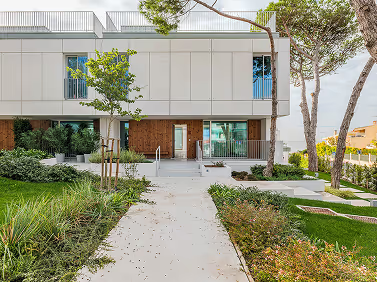

Portugal had its busiest housing market on record in 2025. Prices climbed 17.6% over the year, the steepest annual rise the national statistics office has ever measured, and roughly one in four homes was bought by a foreigner. For anyone arriving from abroad, the agency you choose shapes the entire experience, from which properties you ever get to see to whether the paperwork holds up.
Picking one is harder than it looks. Portugal now has more than 11,000 licensed real estate agencies, a figure that has more than tripled since 2014. They range from large international franchises to one-person operations, and the licence they all carry tells you less about quality than most buyers assume.
This guide covers what the licence actually proves, how to check it in about two minutes, who the agent is really working for, and the questions and warning signs that separate a good agency from a risky one.
Key Takeaways
Choosing a real estate agency in Portugal comes down to a short, repeatable process:
- Verify the AMI licence on the IMPIC public register, and confirm the name matches and the licence is active.
- Ask who the agency represents and who pays their commission. In a sale, this is usually the seller, but in a rental, it is often the tenant, so confirm it for your case.
- If you want someone contractually on your side, hire a buyer's agent.
- Confirm the property's licensing and urban-title status with both the agency and your own independent lawyer.
- Watch for red flags: no licence shown, pressure tactics, in-house-only listings, and no clear written contract.
- Choose the agency that is transparent, responsive, and genuinely experienced with international clients.
What an AMI licence proves, and what it does not
Every legitimate agency in Portugal holds an AMI licence (Alvará de Mediação Imobiliária), issued by the public regulator IMPIC under the 2013 real estate mediation law. To get one, a company has to show commercial good standing, confirm that its holders have no relevant criminal record, hold civil liability insurance of at least 150,000 euros, and pay the registration and annual fees. That is the full list.
Two consequences matter when you are choosing an agency.
First, the licence belongs to the company, not to the individual agent. The consultant showing you apartments usually works under the agency's single AMI licence rather than holding a personal one. There is no national exam or mandatory qualification for that individual, so training and standards vary widely from one agency to the next, and sometimes within the same office.
Second, the licence is a floor. It confirms the business is operating legally and carries insurance if something goes wrong. It does not measure competence, local market knowledge, honesty, or how hard anyone will actually work for you. With more than 11,000 licensed agencies in the market, the licence filters out the unlicensed and little else.
So treat the AMI licence as a pass-or-fail gate, then judge everything beyond it on its own merits.
Step 1: Verify the licence yourself
This takes about two minutes, and you should never skip it.
An agency's AMI number has to appear on its website, its office window, and its property listings. Take that number and check it on IMPIC's public register. Confirm two things: the registered company name matches who you are dealing with, and the licence is active.
If an agency shows no AMI number on its materials, or an agent is reluctant to give you one, stop there. A missing or hidden licence is the clearest warning sign you will get.
Step 2: Know who the agent actually works for
This is the single most important thing for an international buyer to understand, and most newcomers get it wrong.
In almost every residential sale in Portugal, the agency represents the seller. The owner signs the mediation contract, and the owner pays the commission when the deal closes. The agent's contractual duty and paycheque both sit on the other side of the table.
Portuguese law adds two wrinkles. It does not recognise a separate, regulated buyer's agent profession the way some other countries do. And it does not stop the same agency from representing both the seller and the buyer in one transaction, nor does it set rules for handling that conflict. Dual representation is legal, and it is not always disclosed.
None of this makes a seller's agent dishonest. Plenty are helpful and straight with buyers. It does mean their incentives are not aligned with yours by default, so ask directly on the first call:
- Who signed the mediation contract for this property?
- Who pays your commission when it closes?
- Are you representing the seller, me, or both of us?
If you want someone whose contract and loyalty sit on your side of the deal, that is a buyer's agent: a firm you hire to search on your behalf across listings from any agency and to negotiate for you. That is how Ola Estate works, representing the buyer rather than the seller.
Step 3: Understand commissions and who pays
Portuguese law does not fix commission rates. They are agreed freely between the agency and the client and must be written into the mediation contract. In practice rates cluster around a familiar range plus VAT, but the figure is negotiable and varies by agency, property type, and whether the listing is exclusive.
As a buyer, you usually do not pay the seller's agent at all, because the seller covers that commission. What you budget for separately are the transaction costs (transfer tax, stamp duty, notary, legal fees, and registration) and, if you choose to hire one, a buyer's agent's fee, which is a separate arrangement you agree to up front.
[[banner:w-image-1]]
headline: Want to buy property in Portugal?
description: Work with a team that represents your interests at every step
button: Explore buyer support
url: https://www.ola-estate.com/portugal/buying
image: https://cdn.prod.website-files.com/699c52fd0ea2d4bb2148d179/69dc99ee38610685ce3c92b5_08_Conjure_AD%209%20(1).avif
color: blue
[[/banner]]
Step 4: Check how they handle due diligence
A good agency does more than show you properties. It flags problems before they become yours, and recent law changes have made this more important for buyers.
Until 2024, the seller had to present the property's use licence (licença de utilização) at the deed. A 2024 simplification package removed that step and shifted more of the job of confirming a property's legal and urban status onto the buyer's side. A further revision in force from June 2026 now requires the contract itself to state whether the property has a valid urban title. In short, the buyer has to actively verify the licensing of what they are buying.
A diligent agency raises this early and works alongside your lawyer, as our agency does. A weak one stays quiet and lets you find out later. When you interview agencies, ask how they check a property's licensing and legal status, and whether they are used to coordinating with a buyer's independent lawyer.
On that note, make sure the legal checks and contracts are handled by someone qualified who is working in your interest. Some agencies, like Ola Estate, provide their own legal support as part of the service, which can make the process smoother, while others expect you to appoint an independent lawyer. Either way, be clear that the legal side is being reviewed properly on your behalf.
Step 5: Test their experience with international clients
Buying or renting from abroad has its own friction: language, a tax number, a local bank account, remote viewings, and documents moving across borders. An agency that does this every week will save you weeks. One that does not will cost you them.
Useful questions to ask:
- Have you worked with buyers or renters from my country before? Can you share references?
- Can you handle viewings remotely if I cannot travel for each one?
- Who do you work with for the NIF tax number, bank accounts, and currency transfers?
- How do you manage documents and signatures for someone based overseas?
- What does your process look like from first viewing to keys?
Responsiveness at this early stage is a reliable preview. An agency that answers thoroughly and quickly before you have signed anything is showing you how it will behave later.
Red flags worth walking away from
- No AMI number on the website or listings, or reluctance to share it.
- Showing you only the agency's own listings and steering you away from properties held by others.
- Vagueness about who pays their commission.
- Pushing you to skip legal review altogether.
- Any request for money before you have verified the agency and have something in writing.
Green flags worth paying for
- Clear, upfront answers about who they represent and who pays them.
- Willingness to show properties regardless of which agency holds the listing.
- A habit of coordinating with your independent lawyer on legal and licensing checks.
- A written mediation contract that they explain, including any exclusivity terms.
- A real track record with international clients.
[[banner:w-image-1]]
headline: Looking for a long-term rental?
description: Delegate the search to a local team that handles everything
button: Explore rental support
url: https://www.ola-estate.com/portugal/renting
image: https://cdn.prod.website-files.com/699c52fd0ea2d4bb2148d179/69d3c297a90daeeab9240bb8_Container-5.avif
color: orange
[[/banner]]
A note on exclusive contracts
You may be asked to sign an exclusivity agreement (contrato de mediação imobiliária em regime de exclusividade). For a seller, exclusivity ties the property to one agency for a set period. For a buyer, read any agreement carefully before signing, understand the period and the area it covers, and be clear on what triggers a commission. Avoid signing more than one overlapping exclusive arrangement, which can lead to disputes over who is owed a fee.
Frequently asked questions
Do I need a real estate agent to buy property in Portugal?
Using an agent is not mandatory, and foreign nationals can buy property in Portugal without residency or a special visa. That said, most international buyers still work with an agency for the local knowledge, language, and paperwork, which makes the whole process far more efficient and lowers the risk of a costly mistake. You remain free to buy directly from an owner or through your own legal support if you prefer.
Who pays the real estate agent in Portugal?
In a standard sale, the seller pays the agency's commission when the deal closes. As a buyer, you generally do not pay the seller's agent. If you separately hire a buyer's agent to represent you, their fee is a separate arrangement you agree to in advance.
How do I check if a real estate agency in Portugal is licensed?
Find the agency's AMI number on its website, office, or listings, then look it up on IMPIC's public register. Confirm that the company name matches and the licence is active. A licence that is missing, expired, or registered to a different name is a reason to walk away.
Does Portugal have buyer's agents?
Yes, buyer's agents operate in Portugal, although the law does not define them as a separate, regulated profession the way it does the licensed mediation company. A buyer's agent works under a contract with you, searches across listings from any agency, and negotiates on your behalf rather than representing the seller. Ola Estate is one example, working on the buyer's side across the whole market.
Are real estate commissions fixed in Portugal?
No. Portuguese law does not set commission rates. They are agreed freely between the agency and the client and must be written into the mediation contract, so they can vary by agency, property type, and whether the listing is exclusive.