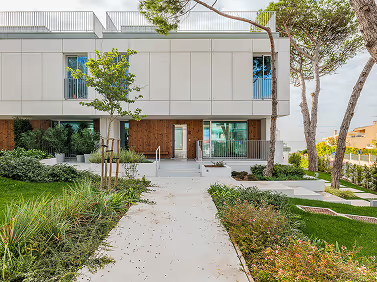

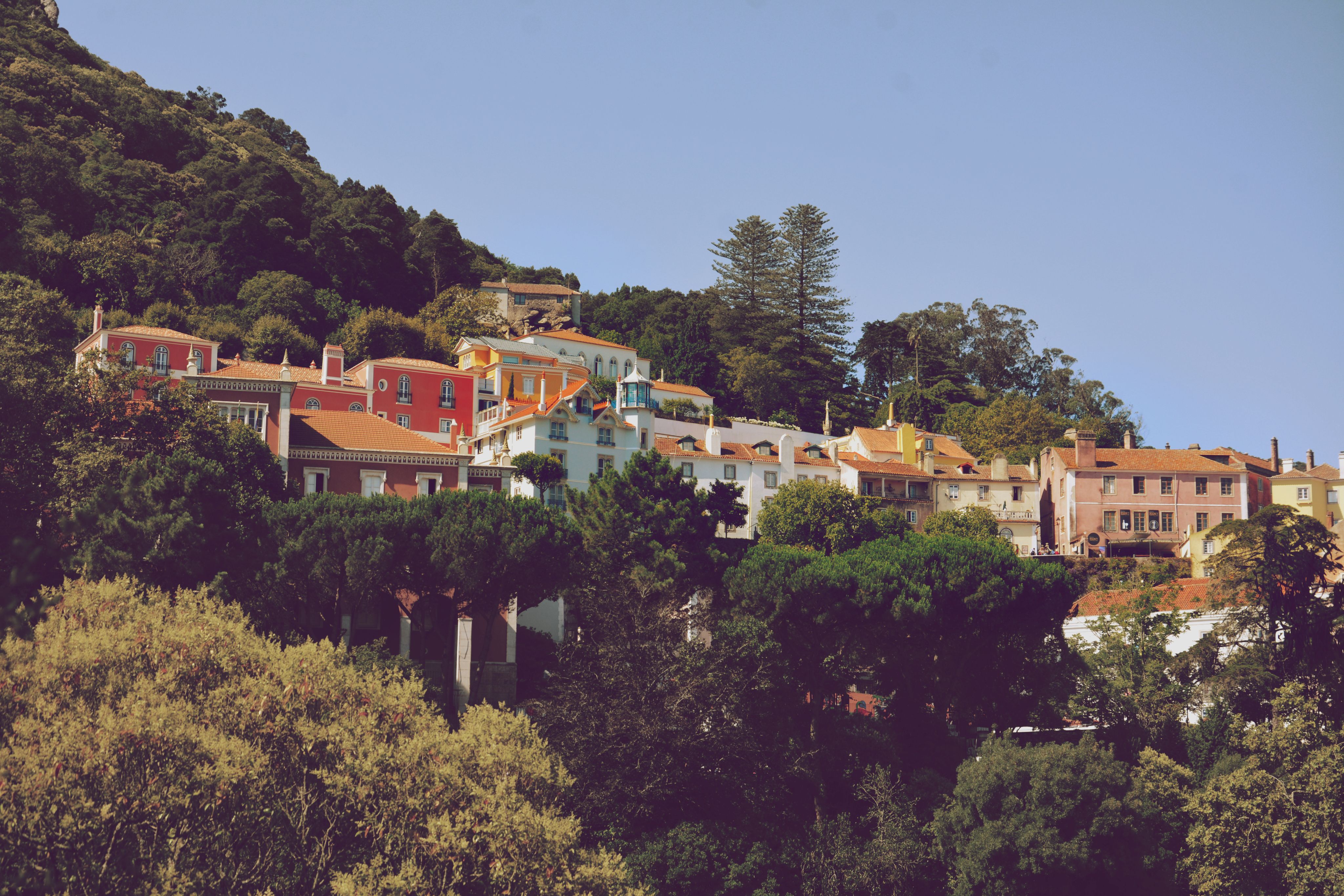
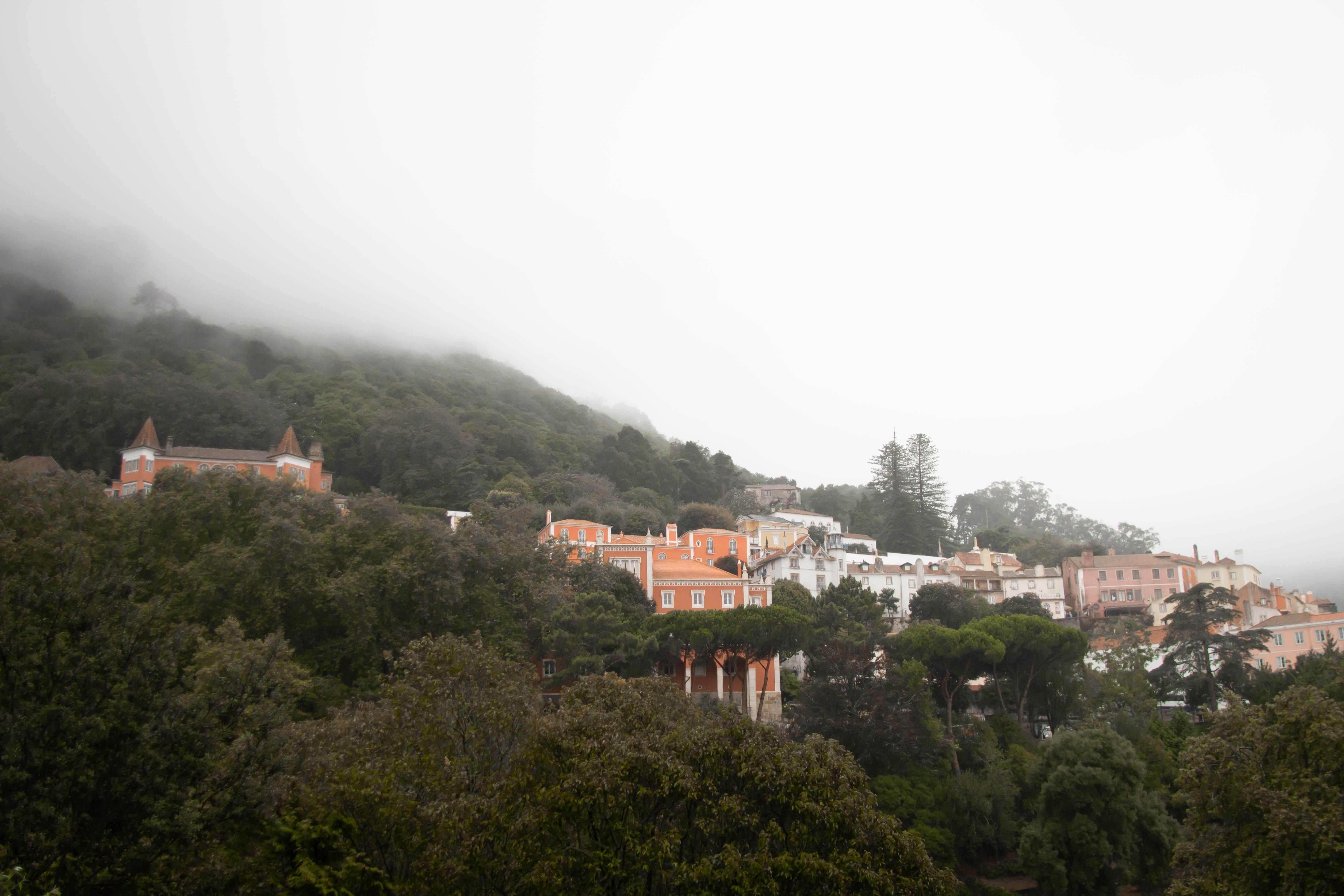
Sintra is the hill town half an hour west of Lisbon where Portuguese kings built summer palaces, where a 19th-century romantic imagination produced a yellow and red castle on a peak, and where the Atlantic mist rolls in and turns the whole mountain into something out of a story. It is a UNESCO World Heritage Site and one of the most visited places in the country.
It is also Portugal's second most populous municipality, with more residents than Porto, and its second busiest housing market after Lisbon. Almost none of those people live in the postcard.
That gap is what this guide is about. It covers what Sintra costs to visit and what it costs to live in, with the registered sale prices rather than the portal asking prices, the enormous difference between the eleven parishes, the new traffic rules that changed how you reach the palaces, and an honest account of what commuting to Lisbon from here actually involves.
Key Takeaways: Exploring Sintra in Six Steps
- Understand that there are two Sintras. The historic village with the palaces holds a small share of the municipality's population. The rest is a dense commuter belt of about 385,000 people along the Lisbon rail line. They are different property markets with different prices, and most guides only describe the first.
- Do not plan on driving to the palaces. Since 2026 the historic centre and the mountain roads are restricted, private cars cannot reach the Pena Palace or the Moorish Castle, and visitors park in peripheral car parks and take a shuttle. Take the train from Lisbon.
- Stop treating Sintra as the cheap option. Registered prices in the municipality rose 28.9% year on year in the first quarter of 2026, the second fastest in Greater Lisbon and well above the national rate. Every one of the nine Greater Lisbon municipalities now sits above the national median.
- Pick the parish before the property. The gap between the cheapest and most expensive parts of the municipality is roughly fivefold. A flat in Algueirão-Mem Martins and a house in Colares are not the same purchase in any sense.
- Test the commute before you commit. The train to Lisbon takes about 40 minutes from Sintra station, and the line is one of the busiest in the country. Where you live relative to a station matters more here than in almost any other part of Greater Lisbon. Ola Estate covers Sintra and the whole Lisbon district, works from what the client needs rather than from one agency's listings, represents the buyer or the tenant, and includes legal review of every contract.
- Budget realistically. A single person renting a one-bedroom flat in the commuter parishes needs roughly 1,500 to 2,100 euros a month. In the village and the coastal parishes, expect considerably more.
Sintra at a Glance
The 1995 UNESCO inscription is worth understanding, because it explains the building restrictions. Sintra was the first site in Europe to be listed as a cultural landscape rather than as a monument or a town centre, meaning the protection covers the mountain, the parks, the estates and the relationship between them, not just individual buildings. If you are buying inside that perimeter, expect heritage constraints on what you can change.
The Two Sintras
This is the distinction that everything else depends on, and it is the one almost no guide makes.
Sintra the village
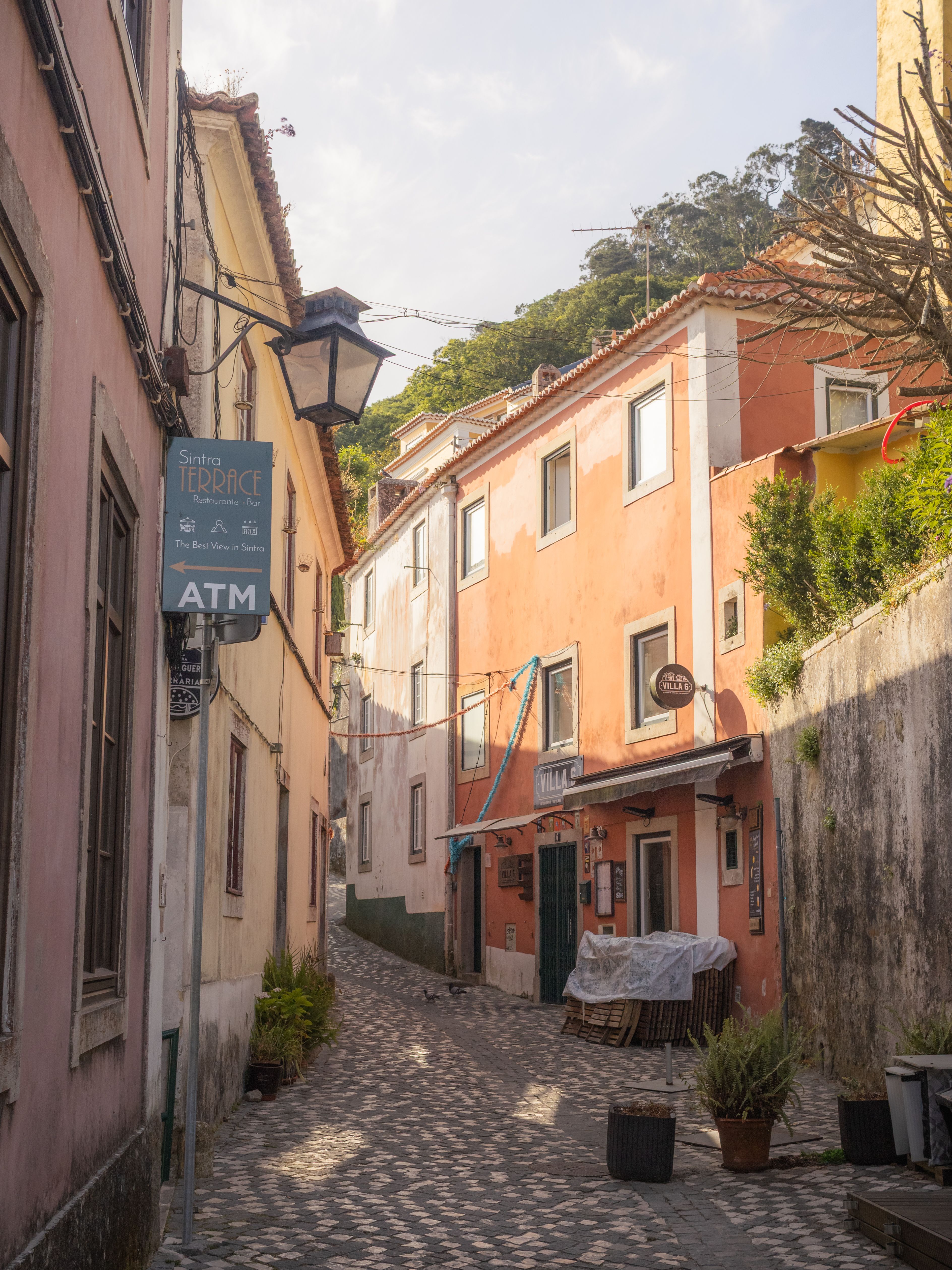
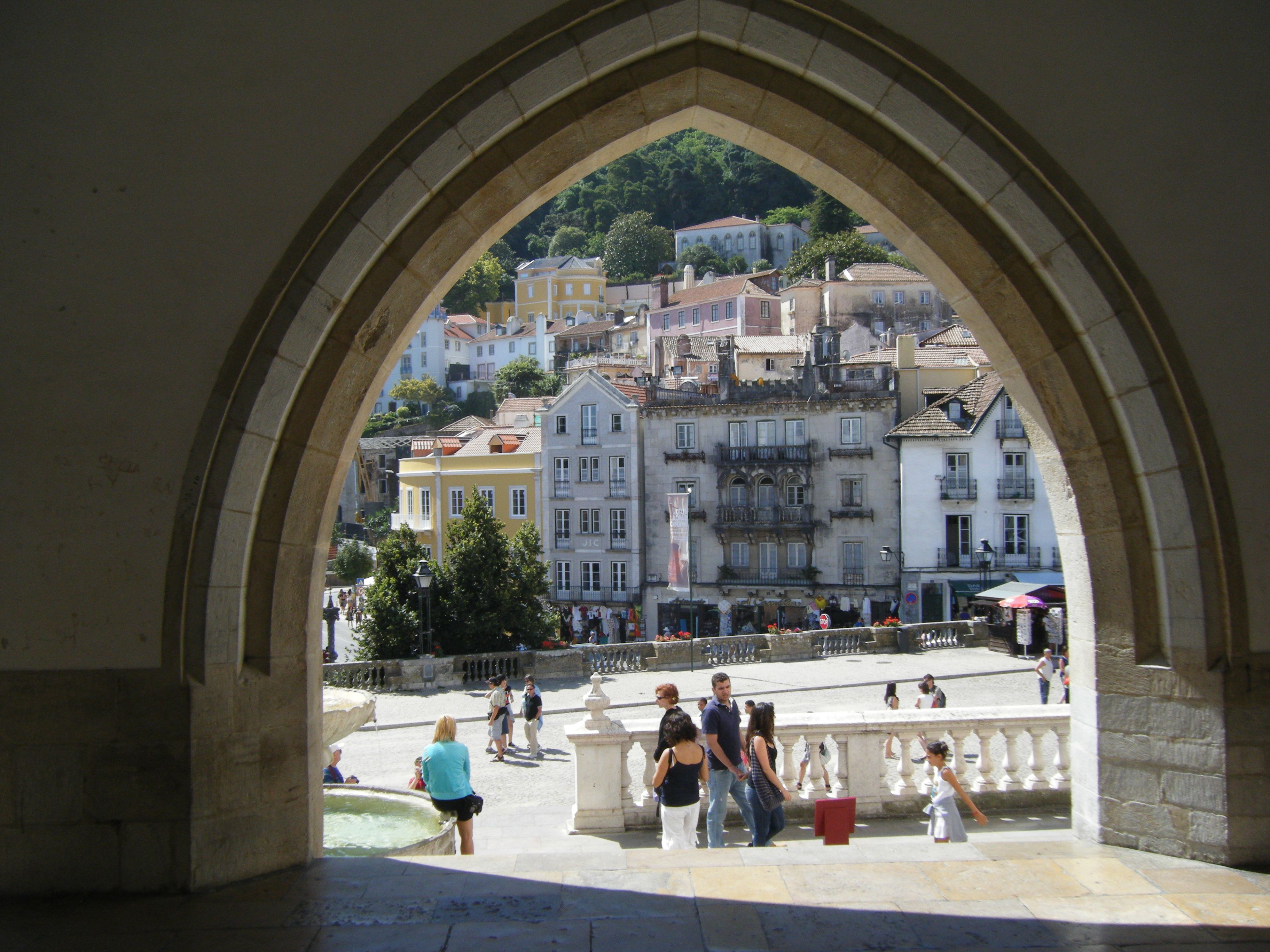
The historic centre, the Vila de Sintra, is a small town of narrow streets below the Palácio Nacional with its two enormous conical chimneys, wrapped in wooded hillside and surrounded by palaces, estates and gardens. Around it sit the parishes of the mountain and the coast: Colares, with its old vineyards and cool Atlantic air, and the villages running down to the beaches at Praia das Maçãs, Azenhas do Mar and Adraga. This is the Sintra that fills the search results and the photographs. It is also expensive and, in the peak months, extremely crowded.
Sintra the commuter belt
East of the mountain, along the railway line to Lisbon, is where the great majority of Sintra's residents actually live: Algueirão-Mem Martins, Rio de Mouro, Agualva and Mira-Sintra, Cacém and São Marcos, Massamá and Monte Abraão, Queluz and Belas, Casal de Cambra. These are dense, working, apartment-block parishes built through the second half of the 20th century as Lisbon expanded outward. Queluz has its own royal palace, a rococo one that most visitors skip. Otherwise these are ordinary places to live rather than places to visit, and they are where the affordable property is.
The practical consequence: when someone says “I am moving to Sintra,” the answer depends entirely on which of these two they mean. One is a heritage market with tight supply and high prices. The other is one of the largest and busiest ordinary housing markets in Portugal.
What Property Costs in Sintra
The scale of the market
Statistics Portugal publishes registered sale prices, taken from what was declared when transfer tax was paid, and the first quarter 2026 release came out on 17 July 2026. Two figures from it define Sintra.
- Sintra recorded 6,151 registered sales in the 12 months to March 2026. Only Lisbon, with 8,095, recorded more. Vila Nova de Gaia and Porto came behind. Sintra is the second busiest housing market in the country, which is not something you would guess from the travel coverage.
- Registered prices rose 28.9% year on year in the first quarter of 2026. That is the second fastest growth of any Greater Lisbon municipality, after Vila Franca de Xira at 32.2%, and it is well above the national rate of 19.8%. Sintra is not the quiet cheap alternative it is often described as.
For context on where Sintra sits in the region: across the 12 months to March 2026 the Greater Lisbon median was 3,598 euros per square metre, against a national median of 2,168. Every one of the nine municipalities in Greater Lisbon now registers above the national figure. Lisbon itself was 5,082 euros per square metre, Cascais 4,687 and Oeiras 4,297, while the lowest in the region, Vila Franca de Xira, was around 2,822. Sintra sits inside that range and below the top three.
A note on precision. The quarterly INE bulletin names some municipalities individually and reports others only in its charts and database annex, and Sintra falls in the second group this quarter. The growth rate and the transaction count above are published figures. Rather than invent a municipal price per square metre, the table below uses current listing medians and is labelled as such.
The parish spread
This is the table that matters, and the reason the municipal average is close to useless. The figures below are median asking prices from current listings, not registered sale prices, so treat them as upper bounds on what actually gets signed. They are included because the relative spread is the point.
The distance between the top and the bottom of that table is roughly fivefold, inside one municipality, under one name. Someone who reads that “Sintra” costs a certain amount has learned nothing until they know which parish is meant.
Two patterns worth noting. First, proximity to a railway station is the single strongest driver of value in the eastern parishes, more so than the parish name. Second, the northern rural parishes around Pêro Pinheiro and Montelavar are the cheapest land in Greater Lisbon and remain genuinely inexpensive, at the cost of being far from both the train and the coast.
What you pay on top of the price
The advertised price is not the total. Budget separately for IMT, the transfer tax, on a sliding scale against the price or the taxable value, whichever is higher; stamp duty at 0.8%; notary and land registry fees; legal review if your agency does not include it; mortgage costs if you are borrowing; and IMI, the annual municipal property tax, from the following year. You need a Portuguese tax number before you can sign the promissory contract. We cover the transfer tax bands, closing costs and non-resident mortgages in separate guides.
Two Sintra-specific points. Inside the UNESCO perimeter and the Sintra-Cascais Natural Park, planning and heritage restrictions are real and can limit extensions, exterior changes and new construction, so check the constraints before you buy something you intend to alter. And on the mountain, damp is the recurring practical complaint: the microclimate that makes the landscape beautiful also keeps old houses wet, so pay close attention to the survey.
What It Costs to Rent in Sintra
The official picture
Sintra signed 5,094 new rental contracts in the 12 months to the first quarter of 2026, the third highest total of any municipality in the country after Lisbon and Porto. It is a deep, active rental market, which is good news for anyone looking.
For regional context, the median rent on new contracts in Greater Lisbon was 14.38 euros per square metre in the first quarter of 2026, and in the municipality of Lisbon 17.42. Sintra sits meaningfully below both, which is the main reason people rent here and commute.
Typical monthly asking rents in the commuter parishes, from listing data rather than official statistics:
The pattern holds across the municipality: rent falls as you move east along the line toward the Lisbon boundary and rises sharply as you move west into the mountain and the coast. A flat five minutes from Cacém station and a house in Colares are not competing for the same tenant.
Deposits and paperwork
Expect to be asked for two to three months of rent as a deposit plus the first month in advance, and often a Portuguese guarantor or additional months up front instead. You will need a tax number, proof of income, an employment contract or company documents, and identification. Insist that the lease is registered with the Tax Authority, because an unregistered contract cannot be used for the rent tax deduction or for residency procedures. We have a separate guide covering the full document list.
What changed in the rental law in 2026
- The 2% cap on new contracts was repealed in July 2026, so new leases follow the market.
- Existing contracts still follow the annual coefficient, a maximum 2.24% increase for 2026, notified in writing within the legal window.
- Tenants can deduct rent against income tax, up to 900 euros in 2026 and 1,000 in 2027, for qualifying registered leases.
Cost of Living in Sintra in 2026
Living costs in Sintra are close to the Greater Lisbon average with the significant exception of housing, which is where the saving is. The ranges below are working estimates and assume the commuter parishes rather than the village.
The Navegante monthly pass covers the metropolitan area including the Sintra line, which keeps the commute affordable and is the main reason the total above stays below a comparable Lisbon budget.
The microclimate is a real budget line
Sintra's mountain has its own weather. It is regularly several degrees cooler than Lisbon, mist and low cloud are common even when the capital is clear, and the western slopes are among the wettest places in the region. In an old, poorly insulated house this means higher heating and dehumidifying costs through the winter and a persistent damp problem in some buildings. When viewing, ask which way the property faces, whether there is any heating, and look carefully at the walls. In the eastern commuter parishes, away from the mountain, the climate is much closer to Lisbon's.
Income context
The national minimum wage in 2026 is 920 euros gross a month, netting 818.80 after social security, and the average monthly wage was 1,694 euros in 2025. Sintra's own employment base is retail, logistics, industry, public services and tourism, but a very large share of working residents commute into Lisbon, Oeiras or Amadora. As across Greater Lisbon, the housing math works comfortably on a foreign or Lisbon-professional income and is tight on a local one.
Commuting and Getting Around
The Lisbon train
The Linha de Sintra is the busiest suburban rail line in Portugal and the reason the eastern parishes exist in their current form. Trains run from Sintra station through Portela de Sintra, Mem Martins, Rio de Mouro, Cacém, Massamá-Barcarena and Queluz-Belas into Lisbon, terminating at Rossio in the city centre, with a branch running to Oriente and Alverca via the Alcântara line. The full run from Sintra to Rossio takes roughly 40 minutes; from Cacém it is closer to 25.
Three practical realities. The line is crowded at peak hours, and standing for the journey is normal. Delays and occasional strike days are a recurring complaint among commuters. And walking distance from home to a station is the single biggest quality-of-life variable in the eastern parishes, more important than which parish you are in. Test the actual commute at 8am before signing anything.
Buses, roads and the coast
Bus networks connect the parishes to each other and to the stations, and there is a service between Sintra and Cascais along the coast. The A16 and IC19 motorways link the municipality to Lisbon and the A5 corridor, and traffic on the IC19 at rush hour is legendarily bad, which is another argument for the train.
For the western parishes and the beaches, a car is close to essential. The coast at Praia das Maçãs, Azenhas do Mar and Adraga is not well served by public transport outside the summer, and the historic seasonal tram between the village and Praia das Maçãs is a tourist attraction rather than a commuting option.
The 2026 traffic rules, which changed everything for visitors
This is the most important practical update in this guide, and older articles all get it wrong.
Under the municipality's Viver e Visitar a Vila de Sintra mobility plan, circulation in the historic centre is now restricted, with control points operated by the municipal police and the GNR on the approach roads. Private vehicles cannot reach the Pena Palace or the Moorish Castle at all, and access to the Quinta da Regaleira is conditioned, with public transport, residents and emergency vehicles permitted.
Visitors are directed to peripheral car parks and then onto shuttle buses. The Lourel car park offers 543 free spaces, with a further 450 north of the Portela railway station and 350 by the municipal planning building, and the shuttle runs roughly every ten minutes. Tour coaches operate on a fixed circuit and may only drop off and collect. Reduced-mobility parking remains available in the centre.
The practical instruction is simple. Take the train from Lisbon, then use the buses and shuttles. Driving to Sintra to see the palaces now means parking on the edge and taking a shuttle anyway, and the mountain roads are closed to you regardless.
What to See in Sintra
The palaces
- Pena Palace, the one on every poster: a 19th-century romantic fantasy in yellow, red and tile, mixing neo-Gothic, neo-Manueline and neo-Islamic elements, standing on a peak above the mist. The surrounding park is large, wooded and worth as much time as the building.
- Quinta da Regaleira, the estate below the village with the initiation well, a spiral staircase descending nine levels into the ground, connected by tunnels. Dense with esoteric symbolism and, for many visitors, the most memorable thing in Sintra.
- The Moorish Castle, the ruined 8th-century walls along the ridge, with the best views over the village and out to the Atlantic.
- Sintra National Palace, in the middle of the village, recognisable by its twin conical kitchen chimneys, with the oldest surviving royal interiors in Portugal.
- Monserrate, further out and considerably quieter, an exotic revivalist palace with Indian and Moorish influences set in an outstanding botanical park. The best value for anyone who wants beauty without crowds.
- Queluz National Palace, in the eastern commuter belt rather than the mountain, a rococo palace with formal gardens that most visitors never reach. It is on the rail line and rarely busy.
- Convento dos Capuchos, a tiny 16th-century friary of cork-lined cells cut into the rock, austere and strange, the opposite of Pena in every way.
Tickets and timing
The main monuments are operated by Parques de Sintra, and the ticketing has tightened. Tickets are bought for a specific date, and the Pena Palace additionally requires you to choose a timed entry slot, with the ticket valid once for that date and time. In peak season the popular slots sell out well in advance. Arrive at the park entrance well before the time printed on the ticket, because the walk up from the gate takes time.
For residents and frequent visitors, Parques de Sintra sells an annual pass that covers unlimited visits, which is worth considering if you live in the area.
The coast and the mountain
West of the village the Sintra-Cascais Natural Park runs to the sea. Cabo da Roca is the westernmost point of continental Europe, a cliff with a lighthouse and, usually, a serious wind. The beaches are Atlantic and often rough: Praia das Maçãs and Praia Grande are the accessible ones, Adraga is spectacular, and Praia da Ursa, reached by a steep unmarked path, is the dramatic one people photograph. Azenhas do Mar is the village that spills down the cliff around a sea pool.
On the mountain itself there is a network of walking trails, including the Santa Maria path that climbs from the village to the Moorish Castle on foot, which is a better arrival than any bus.
What to Do Beyond the Palaces
- Eat the pastries. Sintra's own are the travesseiro, a puff pastry folded around almond cream, and the queijada, a small cheese tart. Both are village institutions and both are best fresh.
- Drink the Colares wine. One of the oldest demarcated regions in Portugal, grown in sand on ungrafted vines that survived phylloxera. Production is tiny and the wines are unusual.
- Walk the trails. The mountain is laced with paths through the park, and walking between monuments rather than shuttling between them changes the experience entirely.
- Surf and swim on the coast. Praia Grande has consistent surf and hosts competitions. The water is cold Atlantic year-round.
- Visit in the shoulder season. Sintra in October or March, in the mist, with fewer people, is closer to what the romantics were describing than Sintra in August.
What Changed in Sintra in 2026
- The mobility plan came into force. The historic centre is restricted, private cars cannot reach Pena or the Moorish Castle, peripheral car parks and shuttles now handle visitor traffic, and new rules apply to ride-hailing vehicles and tour coaches.
- Prices accelerated sharply. Registered prices rose 28.9% year on year in the first quarter of 2026, second only to Vila Franca de Xira within Greater Lisbon.
- Sintra confirmed its position as the country's second busiest housing market, with 6,151 registered sales in the 12 months to March 2026.
- The national rental law was reformed. The 2% cap on new contracts was repealed and the tenant rent tax deduction was introduced.
- Border procedures changed. The EU Entry/Exit System became fully operational on 10 April 2026, replacing passport stamps with biometric records for non-EU short-stay travellers. ETIAS is expected later in 2026.
Things People Get Wrong About Sintra
- That it is a village. The historic centre is. The municipality is Portugal's second most populous, with more residents than Porto.
- That you should drive there. You cannot drive to the main palaces, and the centre is restricted. Take the train.
- That it is the cheap alternative to Lisbon. It is cheaper, and it is rising faster than almost anywhere else in the region.
- That one price applies. The spread between parishes is roughly fivefold.
- That you can see it in half a day. Two palaces is a full day. Three is a rush. Most people underestimate the walking and the queuing.
- That the weather matches Lisbon. It regularly does not. Take a jacket even in August.
- That you can skip the tax number. You need a NIF before you can rent, buy, open a bank account or set up utilities.
Frequently Asked Questions
Is Sintra a good place to live?
For people who work in Lisbon and want more space for less money, yes, particularly in the eastern parishes near the rail line. For people who want the mountain and the coast, it is beautiful and expensive, and it demands a car. The trade-offs are the commute, the damp on the mountain, and the tourist volume in the village.
How much does it cost to live in Sintra?
A single person renting a one-bedroom flat in the commuter parishes needs roughly 1,500 to 2,100 euros a month. A couple needs 2,000 to 2,800, and a family of four 2,700 to 3,900. Living in the village or on the coast raises the housing line substantially.
How far is Sintra from Lisbon?
About 30 kilometres. The train from Sintra station to Rossio in central Lisbon takes roughly 40 minutes, and from the eastern parishes such as Cacém it is closer to 25. By car the same trip can take much longer at peak hours.
Can you drive to Pena Palace?
No. Private vehicles cannot access the Pena Palace or the Moorish Castle under the current rules. Visitors park in peripheral car parks and take a shuttle, or arrive by train and use the buses. Access to the Quinta da Regaleira is also conditioned.
How many days do you need in Sintra?
One full day covers two monuments comfortably, typically Pena and Regaleira. Two days lets you add Monserrate or the Moorish Castle and reach the coast at Cabo da Roca and the beaches without rushing.
What is the best area to live in Sintra?
For commuters, the parishes on the rail line: Cacém and São Marcos, Massamá and Monte Abraão, Queluz and Belas, or Algueirão-Mem Martins, choosing by walking distance to a station. For space and quiet with a car, Colares and the coastal parishes. For the historic setting and the highest budget, the village parishes themselves.
How much are houses in Sintra?
It depends entirely on the parish, and the spread is roughly fivefold. Listing medians run from around 160,000 euros in the rural northern parishes and around 270,000 to 300,000 in the commuter belt, to 570,000 in Colares and well over 900,000 in the historic village parishes. Registered sale prices are lower than these asking figures.
Can foreigners buy property in Sintra?
Yes, with no restriction by nationality or residency. You need a Portuguese tax number, and non-residents face different transfer tax treatment and stricter mortgage terms. Inside the UNESCO perimeter and the natural park, heritage and planning restrictions may limit what you can alter.
Is Sintra always foggy?
Not always, but the mountain has a genuine microclimate that is cooler, mistier and wetter than Lisbon, and low cloud is common on the high ground even on clear days in the capital. The eastern commuter parishes are much closer to Lisbon weather.
Is the train to Sintra reliable?
It is frequent and cheap, and it is the busiest suburban line in the country, so peak-hour crowding is normal and delays are a common complaint. It remains far more reliable than driving the IC19 at rush hour.
Finding a Home in Sintra
Sintra rewards people who know which Sintra they are buying into. A price quoted for the municipality means very little when one parish costs five times another, when a ten-minute difference in walking distance to a station changes both the rent and the resale, and when a beautiful old house on the mountain can come with a damp problem that takes years to solve.
Ola Estate works across Sintra and the wider Lisbon district, in English, Portuguese and Russian. We search the whole market rather than one agency's listings, represent the buyer or the tenant rather than the seller, have our lawyers review every contract before you sign, and can advise on the heritage and planning constraints that apply inside the protected landscape.
Tell us your budget, whether you need the train, and what you want from the area, and we will come back with a shortlist that fits.
Table of content
Discover more regions
Discover more practical guides and local insights

Explore Lisbon: Property Prices, Rent, Cost of Living and What to Do in 2026
Find your ideal apartment in Lisbon’s vibrant neighborhoods with our expert guidance.
Explore Madeira: Property Prices, Tax, Rent and Cost of Living in 2026
Find your ideal apartment in Madeira’s stunning landscapes.